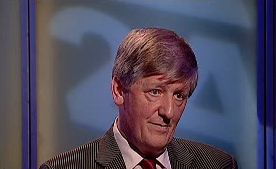
The Ministry of Culture confirmed that the world-renown conductor Jiří Bělohlávek would become the Chief Conductor of the Czech Philharmonic Orchestra. The contract is to be signed later today (Dec 22 2010) and Maestro will take the position probably by autumn 2012.
Mr.Bělohlávek has already been the Chief Conductor of the CP - between 1990 and 1992, and his leaving is viewed as a major mistake on part of the philharmonics and a cause of the twenty-year crisis of the orchestra. He is currently the Chief Conductor of the BBC Symphony Orchestra, with his contract ending in 2012. Some musicians of the CP are worried due to Maestro's notorious high demands, but most people assume that the orchestra needs a firm hand and that Bělohlávek's name will help the prestige of the orchestra abroad.
Source: operaplus.cz
Wednesday, 22 December 2010
Monday, 20 December 2010
Director of Prague State Opera resigned, future of the house uncertain
Second economy-related post today. Oliver Dohnányi, the General Director of the Prague State Opera House, resigned today, after a "friendly agreement" with the Minister of Culture, Jiří Besser, M.D. According to the Minister, Mr. Donhányi is "more of a musician than a manager" and failed to pay off the debt inherited from the previous management (Dohnányi had been appointed by Riedlbauch in June this year). The opera house is, by words of the Minister's spokesman Brunclík, "in a state of despair" and in need of an extensive reconstruction. According to Mr.Dohnányi, the line was so low that there was nowhere to save up.
The opera is now 7,000,000 CZK ($370,000) in debt, while the reconstruction is about to cost tens of millions of Crowns. The length of the reconstruction hasn't been revealed by the Ministry. Even before there were concerns about the State Opera - it has been always losing the competition with the National Theatre. It has been suggested that it should merge with the National Theatre, so that there would be cooperation rather than the counter-productive competition. Some people argued that three opera stages are too many for Prague. As the plans of reconstruction emerged, many fear for the fate of the opera itself, including Mr. Dohnányi:
I'm not going to assist in the liquidation of the opera ensemble
Today at 11 o'clock, I resigned from the position of the General Director of the State Opera. It happened after a long pressure from the Ministry of Culture. At today's audience Culture Minister Jiří Besser informed me for the first time about the plan of the Ministry to have the Prague State Opera Prague comprehensively reconstructed, therefore to discontinue the art business - that in his opinion the post of the Director should not be occupied by an artist, but a manager. If I refused to resign, the Minister I was going to withdraw me on the spot. Minister didn't present me with another reason for the appeal he said that the State Opera has long been in a state of emergency, technically and economically, of which I do not bear the slightest guilt.
I regret that the Minister hadn't informed me of his intention earlier, while I was responsible for developing the project savings in 2011 and specifying the medium-term development concept of the State Opera. I presented to him both the documents. At the meeting on November 22 the Culture Minister also announced that he intends to list as director of the State Opera tender, in accordance with the declared intent to tender for any directors of governmental organizations, who in his opinion haven't passed the selection procedure. At the same time he invited me to take part in the selection process.
I regret that I could not implement the plans that I declared, but I am not going to assist in the liquidation of the Prague State Opera.
Thank you for your cooperation to all who joined me in striving to restore the importance and prestige of the opera house.
Oliver Dohnanyi
The opera is now 7,000,000 CZK ($370,000) in debt, while the reconstruction is about to cost tens of millions of Crowns. The length of the reconstruction hasn't been revealed by the Ministry. Even before there were concerns about the State Opera - it has been always losing the competition with the National Theatre. It has been suggested that it should merge with the National Theatre, so that there would be cooperation rather than the counter-productive competition. Some people argued that three opera stages are too many for Prague. As the plans of reconstruction emerged, many fear for the fate of the opera itself, including Mr. Dohnányi:
I'm not going to assist in the liquidation of the opera ensemble
Today at 11 o'clock, I resigned from the position of the General Director of the State Opera. It happened after a long pressure from the Ministry of Culture. At today's audience Culture Minister Jiří Besser informed me for the first time about the plan of the Ministry to have the Prague State Opera Prague comprehensively reconstructed, therefore to discontinue the art business - that in his opinion the post of the Director should not be occupied by an artist, but a manager. If I refused to resign, the Minister I was going to withdraw me on the spot. Minister didn't present me with another reason for the appeal he said that the State Opera has long been in a state of emergency, technically and economically, of which I do not bear the slightest guilt.
I regret that the Minister hadn't informed me of his intention earlier, while I was responsible for developing the project savings in 2011 and specifying the medium-term development concept of the State Opera. I presented to him both the documents. At the meeting on November 22 the Culture Minister also announced that he intends to list as director of the State Opera tender, in accordance with the declared intent to tender for any directors of governmental organizations, who in his opinion haven't passed the selection procedure. At the same time he invited me to take part in the selection process.
I regret that I could not implement the plans that I declared, but I am not going to assist in the liquidation of the Prague State Opera.
Thank you for your cooperation to all who joined me in striving to restore the importance and prestige of the opera house.
Oliver Dohnanyi
(translation by frufruJ)
Czech Philharmonic must economize, Hvorostovsky cancelled
According to the Ministry of Culture, the Czech Philharmonic must "completely change its economy management". The audit doesn't report any fraudulent activities, rather incompetency of Mr.Riedlbauch and Mr.Darjanin. Mr.Riedlbauch was the Director General from 2001 to 2009, when he became the Minister of Culture of the caretaker government after the international embarrassment fall of the regular government during the EU presidency, and Mr.Darjanin took over.
_____________________________
However, ten months later, Riedlbauch dismissed Darjanin and appointed Václav Kasík - without a tender. After protests by the philharmonics, Kasík resigned at the end of August, and since then the director of the Czech Philharmonic is Radek Zdráhal, a deputy of the Minister of Culture.
Mr.Darjanin had arranged a concert and workshop with the starry pianist Lang Lang, and the season was supposed to end with style, with Dmitri Hvorostovsky's concert in the Spanish Hall of the Prague Castle (it's the beautiful golden-white hall where Obama and Medvedev signed the New Start treaty). The philharmonic are arranging alternate dates for these two concerts, but it seems that it won't be before 2012.
Source of information and images: Czech TV
| Vladimír Darjanin |
| Václav Riedlbauch |
However, ten months later, Riedlbauch dismissed Darjanin and appointed Václav Kasík - without a tender. After protests by the philharmonics, Kasík resigned at the end of August, and since then the director of the Czech Philharmonic is Radek Zdráhal, a deputy of the Minister of Culture.
| Musicians protesting against Kasík in front of the Rudolfinum, suggesting that he got the post out of acquaintanceship. |
Source of information and images: Czech TV
Monday, 22 November 2010
Le Nozze with Plachetka - Standing Ovations at the Estates Theatre
| Adam Plachetka, Kateřina Kněžíková. Photo: National Theatre |
I saw this production more than a year ago, and then I had a few objections - I didn't like the scene of "Non più andrai", the way how Figaro and others behave to Cherubino, and some actions of Rosina in Act II. (namely the obligatory rolling on the floor in a gown, which I find as one of the most annoying clichés in opera direction). HOWEVER this time, the Countess behaved more like a Countess, and what's more important, it was sensible how every singer was enjoying the performance. Even the end of Act I was palatable for me, and even the audience of the Estates Theatre - mostly tourists who take it as an attraction, especially at operas like this or Don Giovanni - was constantly cracking up. I don't know if it's just me having seen one too many eurotrash productions, or if the singers smoothed it up with performing it, or it was special because of the special guest, or all three, but it was a wonderful night for us.
| Kateřina Kněžíková Photo: National Theatre |
History (abbridged)
3050 B.C.- A Sumerian invents the wheel. Within the week, the idea is stolen and duplicated by other Sumerians, thereby establishing the business ethic for all times.
2900 B.C.-Wondering why the Egyptians call that new thing a Sphinx becomes the first of the world's Seven Great Wonders.
1850 B.C.-Britons proclaim Operation Stonehenge a success. They've finally gotten those boulders arrange in a sufficiently meaningless pattern to confuse the hell out of scientists for centureis.
1785 B.C.-The first calendar, composed of a year with 354 days, is introduced by Babylonian scientists.
1768 B.C.-Babylonians realize something is wrong when winter begins in June.
776 B.C.-The world's first known money appears in Persia, immediately causing the world's first known counterfeiter to appear in Persia the next day.
525 B.C.-The first Olympics are held, and prove similar to the modern games, except that the Russians don't try to enter a six-footer with a mustache in the women's shot put. However, the Egyptians do!
410 B.C.-Rome ends the pracitce of throwing debtors into slavery, thus removing the biggest single obstacle to the development of the credit card.
404 B.C.-The Peloponnesian war has been going on for 27 years now because neither side can find a treaty writer who knows how to spell Peloponnesian.
214 B.C.-Tens of thousands of Chinese labor for a generation to build the 1,500 mile long Great Wall of China. And after all that, it still doesn't keep the neighbor's dog out.
1 B.C.-Calendar manufacturers find themselves in total disagreement over what to call next year.
Subscribe to:
Posts (Atom)