Yesterday's recital of the starry baritone, accompanied by Ivari Ilja (the two have released two CDs and can be seen on many videos on YouTube), was without doubt one of the highlights of the very busy season. Hvorostovsky's intelligence of interpretation, depth of feeling, and indeed the sheer beauty of the voice, make him the interpret of this repertoire.
In the beginning it seemed to me that the singer was not in his best of moods - perhaps because of the cold he had, as he said on his Facebook. Not only no indisposition was noticeable, but the atmosphere in the hall was so wonderful that it even warmed up the singer, who seemed much more cheerful by the end. Also I've learnt from a source close to the performers that it was their last concert with this particular content, which might have added to the artists' feelings. The first half of the concert (Tchaikovsky) can be found in this playlist on my YouTube channel and at the bottom of this post, if indeed embedding works.
The program opened with my favourite Why?. Probably because it was the first song, it was a little bit inferior in expressiveness to its counterpart on the aforementioned CD, but that's normal, especially with sensitive performers; during the course of a couple of songs, the recital turned into an event that even Mr.Hvorostovsky can be proud of. The second half featured Medtner's expressive songs (three of them are on the Pushkin CD) and the evening closed with five songs by Rachmaninoff.
The only negative thing I can say is a marginal detail: in the second half of the recital Mr. Hvorostovsky, to my ears, overdid a couple of fortissimi a bit. It was awkward that there was just one encore, yet another art song. One would have thought that such an appreciative audience deserves better, but maybe Mr. Hvorostovsky was tired because of the cold.
Overall however, it was a very strong experience for both those who are familiar with this repertory and those who are not. Hvorostovsky's artistry almost hypnotized the audience. Even knowing these songs almost by heart from CDs, I often found myself completely lost within them, staring jaw-dropped at the singer. One couldn't not smile when he was singing the light Pimpinella or the Serenade Oh, Child. He naturally worked with the people, it almost seemed that he was singing the amorous parts to each woman in the audience. In dramatic or melancholic passages, 100% concentration could be seen in his face. All people I talked to agreed that they could be listening to this till the dawn. Mr. Ilja provided an ideal support. Not only is he an excellent pianist, but also is able to tune-in for the singer and co-ordinate with him - a quality that can't be taken for granted.
This is a playlist featuring the same Tchaikovsky songs at a different recital - this one took place at the Great Hall of the Moscow Conservatory and was aired in January 2010:
***EDIT***
Photos from the concert, by Alice Bochňáková after the jump
Showing posts with label Reviews. Show all posts
Saturday, 28 August 2010
Saturday, 3 July 2010
Antonín Dvořák's Devil and Kate, plus a Note on Devils
Story:
The opera opens in a tavern, where a village celebration is taking place. Music is playing and everybody is dancing, but Jirka, the shepherd, has to go to work, or his master would fire him. Before he leaves, Kate and her mother turn up. Kate would like to find a husband, but nobody wants to dance with her, because she's cheeky and sharp-tongued. She says that she would marry even a devil. At that moment, the devil Marbuel enters the tavern, disguised as a huntsman. He had been sent by the lord of hell Lucifer to investigate whether the princess and steward have committed enough sins to be taken to hell. He wants to tease Kate and punish her a little for her sharp tongue, so he asks her to dance and proposes her to leave with him. When she agrees, he takes her to hell. Then Jirka returns, saying that his master had sent him to hell. When he hears what happened, he decides to save Kate.
Saturday, 13 February 2010
Leoš Janáček: The Makropulos Affair
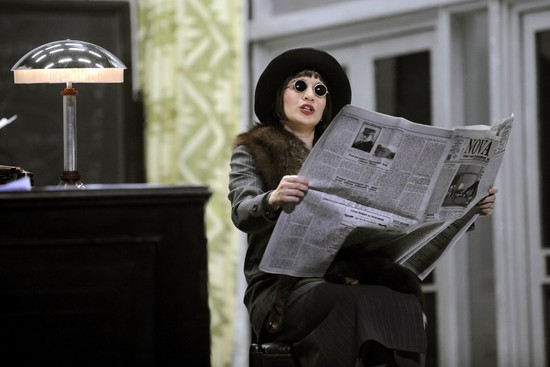
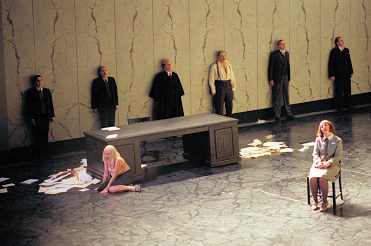
While Christopher Alden's production has been praised by the critics both here in Prague and in England, I am not so positive about it.

Janáček's opera, based on Karel Čapek's play, is about the last few days of Elina Makropulos. Thanks to a magic potion, she has lived for more than 300 years. She's grown cold and cynical, but the life experience gives her an aura which, together with her appearance, drives all men crazy - about her. The relatively short opera (1:30) is written in a modern fashion, close to expressivism; after all, it was composed in the 1920's. Only in the end, when E.M.'s vulnerability and despair is relieved, the music suddenly grows into a lyrical finale, strikingly contrasting with the rest.
Čapek's play is actually a philosophical comedy. However, I believe that the story is open to various approaches, and Janáček's opera with the added death of E.M. in the end is hardly a thigh-slapper. I suppose an absurd comedy (a genre typical for the Czech country) or a realistic, deep psychological study are the possible approaches.
Mr.Alden, on the other hand, chose to set it into a noir world of shades of gray, in which people behave without much restraint. His production is an example of the general tendency in today's opera world to "coolify" everything from Baroque. Everything must be cold and erotic, beauty and sensitivity are taboo.
This wouldn't have to be a problem in an absurd dramedy, but only to a degree. Mr.Alden had many interesting ideas, obviously understands the opera, his direction is very intelligent and I find the basic concept quite valid. So much for the good news.
Restraint isn't a word to be found in modern directors' vocabularies. Where a suggestion would have been just perfect, we get everything in the face (including one taking-off of a shirt - there must be one in every prod!). Even given the hyperbole and symbolism of the production, characters lacked a concept of personality, their behaviour being quite illogical. When the philosophy behind should have been stressed, it was overshadowed by the darkening and eroticizing. Even though this is just one paragraph in this review, it's a big problem with the production. The worst in this aspect was Act II, which was simply overdone.
My impression of Alden's production is 70%. The singers were good, especially Gun-Brit Barkmin in the title role was great, and the acting was excellent, so it's definitely worth seeing.
Sunday, 13 December 2009
Martinů:The Miracles of Mary, ND
In short, it was a night to remember. Few works are as overwhelming as this masterpiece by Martinů. It is beyond me why it is so underperformed. Let me quote here the program:
"Its central theme, inspired by medieval miracle plays and legends, is the benevolence and compassionateness of the Virgin Mary, and in the wider sense (and above all) womanhood – wise, foolish, sinful, vain, affectionate, self-sacrificing, munificent..."
The opera comprises of four parts: The Wise and Foolish Wirgins, Mariken of Nimégue, The Nativity and Sister Pascaline. It is based on medieval liturgical plays, which developed as detours from the Christmas story and were the first plays in the area of the Czech lands. Martinů used all forms of performing art - solo voice, choir, spoken word and ballet.
The first mini-story seems a bit out of place here. Based on an Old French liturgical play, it's a story of virgins awaiting the groom - Christ. They are to keep their laps lit, but some of them fall asleep and the oil in their lamps dries out. They beg their friends for oil, they beg the merchants with oil, but to no avail. They are damned without mercy. Considering the Christian view on the forgiving God, and the three remaining parts, it is truly surprising. The only explanations I can see are that it is either on a higher level of symbolism than we presume on the first sight, or just to scare people from falling into sin too easily.
All three stories are about women gone astray, but Virgin Mary helps them find the way. Mariken, both here and in the opera's source, an old Flemmish play, marries the Devil and lives with him for seven years. After seeing a Christmas play by a wandering group of actors about the forgiveness of Jesus, she suddenly understands and rejects Satan. He kills her, but her soul is saved.
The Nativity is highly inspired in folk traditions of the plays, depicturing Virgin Mary looking for a place to give birth to little Jesus. She is rejected both at the inn and in the smithy, so she goes to the barn. The blacksmith's one-armed daughter comes to see little Jesus, and her missing arm is restored by miracle. The blacksmith, upon seeing this, is sorry that he didn't help Virgin Mary earlier.
Sister Pascaline, not getting any escapes from the monastery to live with her beloved, but Devil kills him and arranges that it looks like Pascaline is the murderer. She is to be burnt at stake, but Virgin Mary saves her. When Pascaline returns to the monastery, she is told that sister Pascaline never left. It was Virgin Mary who back then took her habit, so that the sisters wouldn't know about her past, now giving it back to her. Pascalina, moved by Mary's mercy, gives her soul up for God.
The stories might be simple, but the opera is not. Martinů used French miracles, folk Moravian poetry, liturgical texts and Psalms. The opera itself is highly modern, primarily in its main concept and its approach to metaphor. A recurring character, joining all four parts, is the spoken role of the Leader of the Play. It sounds almost like a miracle that Martinů managed to put all these pieces into a functioning opus, but the result is breathtaking.
The direction was again modern, BUT, this is a huge but, completely and utterly followed the music and the words - unlike what some of us has learnt to understand "modern direction". It was a solid counterpart of the composition itself. Only in one moment in the first part was I afraid that the director, Jiří Heřman, would fall into profanity, implying a mass rape of the "foolish virgins", but everything was calmed again without spoiling the atmosphere by anything unnecessarily violent (I feared for the many nuns in the audience, you know...). Jiří Heřman chose to work primarily with a set of different curtains AND light. Settings were changed simply by turning panels on the sides. The only props were tables on wheels. The resulting effect, though it can hardly be called "minimalistic", was just perfect.
Choreography, as much as I'm not too much into ballet, was extremely well done. Jan Kodet is arguably the best Czech choreographer, having worked with many Europian ballet companies.
As far as the voices go, nothing bad can be said. I was especially positively surprised by the low notes of the female protagonists. I can't complain about my turn of cast, being familiar with most of their names and voices from other operas. The actor Jakub Gottwald, playing the Leader of the Play, could be understood, even across music - a rare feat among today's actors, it seams.
Last, but not least - the music. Jiří Bělohlávek, what else can I say? The music just enwraps you, a magic happens and you are taken to another world. Perhaps I should only add that a special mention should go to the pianist, Libuše Klausová, and the violinist, along with the rest of the National Theatre Orchestra.
Overall, it was one of the most overwhelming opera experiences I've ever had. I almost don't know whether seeing it once in a lifetime is not enough - could another production ruin the memory of the experience? If opera houses are less focused on Verdis and Puccinis, we can find out, but once - it's a must.
Saturday, 10 October 2009
FruFru's Attitude towards Opera Productions
"When the curtain opened on La rondine at Covent Garden, the audience gasped and applauded. People want to dream. If directors want to do something new with operas, why not do something beautiful?"
In response to the recent talks about the new Tosca at the Metropolitan Opera, directed by Luc Bondy, I came to the conclusion that it's about time for me to summarize what I actually think. I'm open to discussion. An "IMHO" applies to all of it, as a matter of course.

Angela Gheorghiu
Yes, I do think that Carsen's Rusalka was bad, and no, I'm not afraid to say it.
Firstly and primarily, my opinion is that a director is just another interpreter - next to the conductor and the soloist. He or she should be seeking the best ways how to present the author's vision to the members of the audience.
The most often performed operas were composed in the 19th century. Everything about them is romantic (or "Realistic", haha). The problem of most "modern" productions is that they interfere with the opera, rather than interpret it. Dvořák composed a romantic fairy-tale, Carsen directs it as a psychological drama, making everybody who understands Czech laugh their head off. The reason for giving this example is the critical acclaim of this production. If you want a DVD with Rusalka, you can choose between an English one and this one.
My favourite simile is that to a painting and a frame. Operas are like Romantic or Realistic paintings. They work the best in those wooden, artistically crafted frames, OR in frames which don't interfere with them. On the other hand, can you imagine a Géricault in, say, a neon frame? No matter how interesting the frame is, its task is to frame a painting by Géricault, in which it fails.
According to many today's philosophers, the Enlightenment fable, that "the newer, the better", is rooted deeply in our society. A director will be praised (because the booing ones will be put aside as philistines), if his/her production is "innovative". As if there were the connoisseurs on one side, and the conservative grannies (whom every decent connoisseur scorns) on the other side.
Not that I am saying that Carsen is a bad director or that we should have a set amount of productions repeating. Even though, it's not a bad idea - just like we have a set amount of classical operas, musicians are trying to find the best way within what they offer... Imagine directors studying day in, day out, how to approach a Zeffirelli! Anyway, everybody should be reasonable, and not lament on the absence of candles in a Tosca, but, at the same time, not approving Tosca resting on a couch and revel in the sight of the dead Scarpia. Or any of the many things wrong with this production, for that matter.
A word [a little] against the "traditionalist" productions. I think it is actually quite difficult to direct such a production. Yes, if you fail, you don't insult anybody, but there are as many productions which lack some chemistry and are essentially boring, as the abortive "modern" ones.
Respect, man, just a little bit. For the author, performer, work, everything.
Just an off-topic footnote: Why do so many directors seem to relish in being despotic? It's a psychological 101, especially in a performing genre. The actor (singer) must know your (director's) intentions, and must trust them and agree with them. It's a hard enough job, why make it even harder by pushing them to things? Moreover, they might come with something useful on their own. A good leader is not a tyrant.
Sunday, 20 September 2009
La Finta Gardiniera @The Estates Theatre: Mozart & Dwarves
La Finta Gardiniera was finished when Mozart was only 18 years old. His arguably longest opera, in the old style of a looot of repeating in the arias, can probably be a tad bit... ahem... boring. Not so in the production of Ursel and Karl-Ernst Herrmann.
Their more than twenty year old production of this underperformed opera, obviously televised in 1989, leaves little to be desired. Unlike their Clemenza di Tito, which I saw in this theatre two years ago and where they committed many UIF (UnIntentionally Funny) and WTF crimes , this production was very funny in the light Mozartean fashion.
Yes, I was a little worried when it began with a dwarf reciting Heinrich Heine while crawling up from the underground. However, within some twenty minutes, it was clear that it would be a pleasant evening. The Herrmanns' clever and fast-paced direction was (nearly) fully supportive to Mozart's almost Shakespearean comedy. Unlike many "modernized" productions, it was not trying to be "wiser than the author," and the sets offered a basis for many comic gigs. There was no ugliness or violence, so necessarily present in many today's productions. Nothing of the sets was there just pro forma, and even the shy Czech audience (well, at least half were Czech...) found it too difficult to muffle their laughter at times.
From the musical standpoint, there are no complaints on my part. Especially as Prague's opera sweethearts, Kateřina Kněžíková and our barihunk Adam Plachetka, were showing off not only their beautiful voices, but also a great deal of comedy talent. Plachetka can also be seen in Vienna, he had the "luck" of appearing in the fugly Salzburg Rusalka, and in three year's time, he will perform Masetto at Covent Garden. However, most of the cast was international, which opens some questions as to whether there are enough reasonably good Czech singers here. All that under the steady baton of Tomáš Netopil's, the new (and very young) chief-conductor of the National Theatre.
Overall impression: 85%
Adam Plachetka & Kateřina Kněžíková
Photos from their respective official sites.
Wednesday, 16 September 2009
A Message to Critics
Perhaps this is a futile effort, as few of those whom this post is addressing - the harshest critics, both professional and amateur - are going to take it to heart. However, if a single person thinks again about what he or she writes about performers, it has not been in vain.
From the movie The Great Caruso, starring Mario Lanza (even though the film was highly fictionalized, the part about Caruso being compared to de Reszke and called "bourgeois" is correct, just like [both] de Reszkes' admiration to Caruso):
Not that I am blameless. Sometimes it's a difficult job not to be harsh, when music is your passion, and you hate some of its parts just as much as you love others. But we all should think twice, whether what we are saying or writing is truth, or if it is just a little frustrated musician in us talking.
In Art, few things are objective, and what one person likes, another may not. YouTube seems to be full of all too wise people who know a singer's technique is wrong, how a world star is terrible, or how a conductor's fame is just good PR. These are exactly the people who would criticize Enrico Caruso for not being Jean de Reszke; now they criticize Dmitri Hvorostovsky for not being Lawrence Tibbett, or Renée Fleming for being vulgar.
Artists are extremely sensitive beings, but in this ugly world, they either develop thick skin, or can't do what they love - sing, play, conduct. Everybody who can perform in public in the first place is great, because they are bringing Beauty to our lives. By savaging them, you're betraying the very essence of Art.
Life's too short not to enjoy world's beauty and loose time with what you dislike, or to annoy other people by not respecting their tastes!
Wednesday, 2 September 2009
How to Become a Successful Opera Director
The Ten Commandments of Opera Directing, by Frufru:
McVicar, who else?
Rule no.2: Make a character gay.
Rule no.3: Make a character naked.
Rule no.4: Or both.
Rule no.5: If somebody dies, there should be a loooot of blood. No matter it's considered a mark of second-class horror movies.
Rule no.6: If an opera goer has to read through a manual to get a hint of what you're trying to say, you're on the right track.
Rule no.7: Use as much cliché as you are able to put in. Cliché in an artistic genre is considered to be "innovative approach."
Rule no.8: By ANY means whatsoever, don't get yourself troubled by the libretto or the score. The *story* is the important thing, and it has to be *retold.*
Rule no.9: Fire a soprano or two. Just to gain popularity. You'll always find a reason - too fat, too short, too tall, too bad an actress... doesn't want to undress creative differences...
Rule no.10: If half of the audience are booing and half are cheering you, you've achieved your goal. From now on, you'll be hailed by critics as one of the best opera directors, and DVDs will be sold only because your name is in the credits.
Tuesday, 1 September 2009
Il Trovatore in London, 2009
As Mostly Opera nicely put it: "So we are supposed to believe that the soprano kills herself to avoid sleeping with this guy? Right..."
I was awaiting a moment when Mr. Hvorostovsky appeared in Europe in a live, un-amplified concert, or in an opera where the baritone role is not too small and where I didn't have to be disgusted by some director's "retelling" of the story. I nearly gasped when I saw that he would appear in London, as il Conte di Luna, with Sondra Radvanovsky and Roberto Alagna, in the somewhat clumsy but traditionalistic and appealing Moshinsky's production.


It was my first visit of London, and of a big, famous opera house, too. I arrived in Covent Garden well before time, as I had intended to walk, but the rain was so heavy that I decided to take a cab. From the phonetic standpoint, the driver was a very nice Cockney guy, the doormen and ushers at ROH spoke "received RP" - the most understandable accent for foreigners - and most of the audience members and cashiers were native RP speakers (the cashier I spoke to when I was picking up the ticket had an especially arrogant tone in his language).
When I came in, I decided to dissolve my boundless excitement in a glass of wine and sit at a table there. If you, like me, have problems with low blood pressure, or any other reason why you prefer to sit down, I must recommend you to arrive *at least* half an hour before the performance. The room got crowded quickly, so that there was nowhere to sit, and the auditorium opens just ten minutes before the performance.
I invited a lovely elderly English couple to sit at my table, we talked mostly about opera. They had seen Rusalka in English, and they had visited Prague. They said that they liked the city, but in such situation, I always fear the people are just being polite... Well, come and see for yourself :-). We also talked about the dress code. We couldn't agree more that people should dress nicely, to show to the surroundings *and* to themselves that this is a special occasion. They told me that some twenty years ago, long gowns and tailcoats were common. I confessed that I had been afraid of being underdressed, but that fright was soon gone, after having seen a guy there, a tad bit horizontally challenged, dressed in casual jeans, army green pullover and white sport shoes. It spoils the impression a bit, when you see such a figure. While we're at the fashion policing, Mrs. Hvorostovsky, who was also there, chose the elegance of little black dress, Maestro Orbelian was wearing a dark suit.
Then the performance began. Mr.Moshinsky had been criticized for this production of his, that the sets take too much time to change, that it's all too static etc. That was apparently the reason why he chose to reduce the number of flats, which I found very unfortunate, especially in the third act. I was also looking forward to the first act fight between Di Luna and Manrico. Yes, Mr.Alagna is a half-pint, but quite athletic, I mean, I wouldn't force Johan Botha to it, but I think Alagna could have pulled it off... However, Moshinsky decided to go for the "Leonora-prevents-the-fight-until-the-curtain-falls" option. There was some fighting in the convent, but there they forced Di Luna to lay on the ground, in the fashion of American cops arresting a suspect. I was sitting in the second row, and feeling the urge to bounce from Maestro Rizzi's head and help Dima out. Anyway, forcing him down was a bit unnecessary. The great news was that Moshinsky crossed out the gayish ballet-fight in the third act, which 1. was weird and 2. didn't match the overall concept of the production. Instead, the chorus members were singing, sitting on chairs at the edge of the stage, with several stunt-men (?) showing-off their impressive fencing abilities behind them. The Di quella pira reminded me of Lt. Columbo; Manrico went away and returned a couple of times, like the repeated line "Oh, there's just one other thing..." The last change to the original production was, Di Luna did not shoot Manrico to death, but stabbed him in an outburst of anger, having realized that Leonora killed herself because of him, and Manrico died in his arms. I very much like the idea of the Count killing his brother with his own hand, and this worked just perfectly.
As for the singing: Ms.Walewska as Azucena was very good, if somewhat insipid in comparison to the starry cast. Ms.Radvanovsky has a big voice, and frankly, I can't understand the people who keep criticizing her for some reason. She appears to be the best Verdian soprano around these days, and I like her approach to her roles, too. Mr. Alagna was a very pleasant surprise. To be honest, I was expecting a disaster, having seen him as Radames on the DVD, but he pulled off Manrico very well. Last, but not least: Dmitri Hvorostovsky. People say that he's got a small voice - to me he sounded louder than Alagna. People say that he's not a "true" Verdi barytone - that was perhaps true ten years ago. The singing, the acting, the feeling, the man. I am happy and honoured that I have seen one of history's greatest baritones at his best.
So Il Trovatore ended. I was almost shocked by how short the applause was - only one curtain-call?? I quickly went to the stage exit, hoping to meet Mr. Hvorostovsky, but apparently, he had gone earlier, or through another exit, if that is possible. However, I met Maestro Rizzi, and I got an autograph from Mr.Alagna. Of course, the only thing I had forgotten was a pen, but I met a lovely Polish woman there. She was standing a bit aside, so she was an easy victim of my attempts of conversation. Her English was not too good, so I asked her where she was from, and she said, Poland. I said "Já jsem z Čech" (I'm from Bohemia), and she said "Tak to možem po našom" (So we can speak our languages). I have a feeling that the Poles understand Czech better than the Czechs understand Polish. She lent me the pen and showed me the members of Roberto Alagna's family. She was there alone, going back to Poland in the morning. As we were leaving, she said she would take a walk through London by night, I hope she got to the airport safely.
Well, and that's it. The evening of wonders was ended. One thing is for sure, that I will remember it for the rest of my life.
Wednesday, 19 August 2009
A Review of Netrebko's Videoclips from the DVD "The Woman, The Voice"
I'm going to be untypically harsh here, but I can't attempt to like modernized opera and remain nice at the same time.
Anna Netrebko is not one of my favourite singers, but she's far from bad and she's nice to look at. Especially in a videoclip. That's what I thought when I was downloading purchasing her DVD. Upon seeing the screenshots, I thought it would be interesting.
As I'm not interested in Ms.Netrebko reveling in talking about how she loves shopping in boutiques, I kept fast-forwarding to the videoclips, scattered on the whole length of the film. I quite liked the first one, Musetta's waltz. You could argue that it doesn't retain the spirit of the aria, but none of the videoclips here does. Musetta's waltz video is elegant, even though it somewhat lacks invention (what operatic videoclips don't?). I was especially annoyed by the switching to the black&white shots, but I liked the way she and the driver exchanged glances in the beginning *wink*! I guess this balancing on the edge of cliché is a match with Puccini.
However, the videoclips that followed were not short only of invention and originality, but also a slightest hint of style, pretending to be artistic. The diva is running/standing/lying around, with no further ideas to it. Vincent Paterson, the director, obviously thought that "the woman and the voice" is enough for a videoclip. He stayed half way between the traditional, where not so many things happen and you are left to enjoy beautiful music accompanied by beautiful pictures (as Sumi Jo's clip), and the progressive. He managed the almost impossible: modern opera clips which are boring.
The second clip was the Jewel Song from Faust. Ms.Netrebko in three very different settings for no apparent reason doesn't do anything but puts on jewels and adores herself in the many mirrors. Isn't that enough? Eh, not for me, especially when the settings are so kitschy.
A sparkle of hope came with the Don Giovanni clip, even though it immediately reminded me of the walking-talking trees in the Russian fairy-tale film Morozko (Jack Frost) and Titus. Unfortunately, the director again did nothing about it, so "the woman" is left there among the dancing trees, only opening her mouth to "the voice" and moving arms. Plus, there are several moments when the camera is so bad it's attracting attention.
La Sonnambula clip is so eurotrash it's almost useless to analyze it. The director knew no better way how to make it interesting than "the weirder, the better." It's tasteless, pointless, but at least not boring.
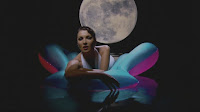
The Song to the Moon clip has been critically acclaimed, even by people who didn't like the other videos, but the reason escapes me. I'm amazed that so few people are capable of understanding the fact that Rusalka (opera) is a delicate and tender tragedy. The very *point* of it is that Rusalka (character) has got pure heart. There's a certain naïveté in her, but also strength: she sacrifices everything, is betrayed, but does not betray her love. Netrebko's approach to the aria is shallow every time, but when accompanied by a videoclip where she sings opens her mouth lying on a floating mattress, in a nouveau-riche style, with a giant moon behind her, it's just making fun of Dvořák and his depth. Otherwise, the clip is well structured, its only problem is that it's just as superficial as Ms.Netrebko's interpretation. Rusalka coming to the Prince when he's having a shower?
Well, I'm sure everybody who reads this review, including myself, will love the videoclips as a result. It's the expecting-a-disaster effect. If you like eurotrash productions and/or adore Anna Netrebko, I'm sure you will enjoy this DVD. However, it's almost a pity that she wasn't given the opportunity of having a documentary like those about Rolando Villazón or Elina Garanča. What actually saddens me the most is the wasted potential. Some clips look good at first sight, but the director let it all be as if unfinished, just the basic concept with no idea.
...But the pics look nice, don't they? Click to enlarge:
Musetta being neglected
The black&white inside life of the poor Musetta, who is neglected by her husband, which led her to having an affair with the driver. Which opera is this from?
Three snapshots from The Jewel Song, no comment
It looks beautiful, pity there's no meaning to it.
♪♫ Non mi dir ♪♫
La sonnambula. Flirting with an old man with pigtails on his beard. You should know that on the table there's a cake in the shape of a female leg.
Poor Bellini
Rusalka?

I bet you didn't believe me the one about the shower!
Unfortunately, 90% of the time of the DVD we see just this:

Subscribe to:
Posts (Atom)